
Written Off While Still Financed
When the insurance payment does not clear the loan
When a financed vehicle is written off, the insurance settlement does not automatically equal the finance payout.
If the vehicle has depreciated faster than the loan balance—particularly where the finance includes a balloon payment—the owner or business may be left with a shortfall and still need to fund a replacement vehicle.
The following fictional but realistic example shows how purchase price, current vehicle value, insurance cover and finance can produce four very different figures.
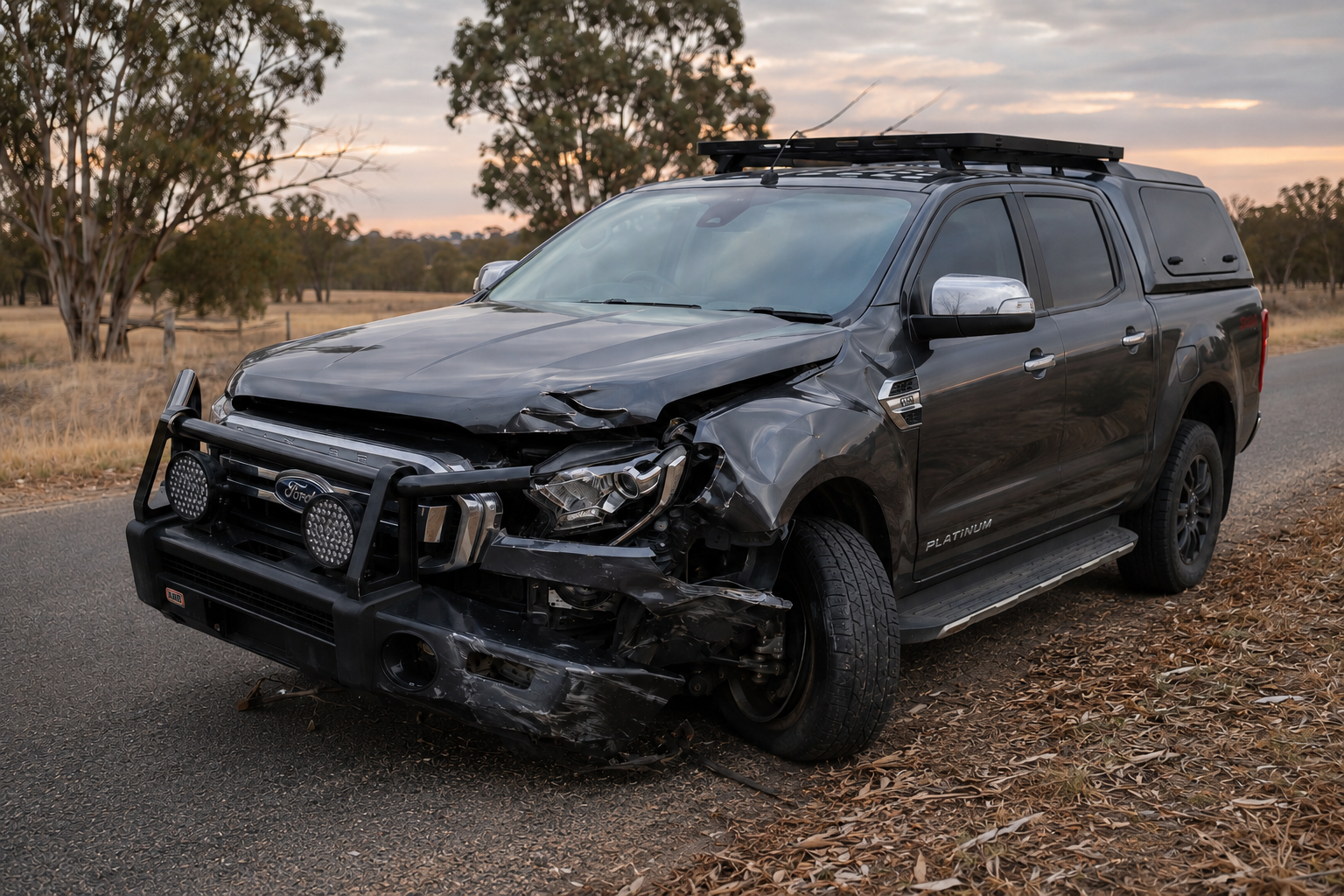
The Ranger was exactly what Mr A needed
Mr A had recently started a small business and needed a vehicle that could serve two purposes.
During the week, it had to carry equipment and support the business. On weekends and holidays, he wanted a comfortable and capable vehicle that could tow the family caravan.
A new Ford Ranger Platinum V6 appeared to meet those needs perfectly. It was well equipped, comfortable and capable of towing up to 3,500 kg when correctly configured.
The Ranger cost approximately $85,000 on the road. Mr A then added a colour-coded canopy, bull bar, driving lights, roof platform, electric brake controller, underbody protection and other quality dealer-supplied accessories.
By the time the vehicle, accessories and associated costs were included, the total transaction was approximately $105,000.
The finance appeared straightforward
Mr A obtained vehicle finance through the new business using its ABN. The approval process was relatively straightforward.
The finance included a substantial balloon payment. This lowered the regular monthly repayments and helped the business preserve cash flow during its early growth.
Mr A understood that a lump sum would remain at the end of the loan. What he had not considered was what could happen if the Ranger was written off before the finance term ended.
The vehicle was comprehensively insured. The policy schedule showed a substantial Sum Insured, and Mr A believed the Ranger and its accessories were properly protected.
Then one evening, everything changed
Approximately 18 months after purchasing the Ranger, Mr A was travelling on a country road when a kangaroo entered his path.
He struck the kangaroo, lost directional control and left the sealed roadway. The Ranger travelled onto the rough shoulder and sustained further damage before coming to rest.
Fortunately, Mr A was not seriously injured and no other vehicle was involved.
The insurer accepted the collision and resulting damage as an insured event. The applicable excess still had to be paid, and there was no third party from whom the loss could be recovered.
At first, the Ranger did not look completely destroyed. The frontal damage was substantial, but Mr A expected that a relatively new and valuable vehicle would be repaired.
The insurance assessment produced a different result.
Why the Ranger became a total loss
The visible damage was only part of the problem.
The assessment identified damage involving the front structure, suspension and steering components, cooling systems and restraint equipment. Electronic driver-assistance components would also require replacement, programming and calibration.
A safe and correct repair had to account for:
manufacturer-prescribed repair methods;
structural measurements and repair limits;
replacement of one-time-use components;
airbags and seatbelt restraint equipment;
cameras, radar and parking sensors;
suspension alignment and integrity;
post-repair diagnostics and calibration;
parts availability;
possible additional damage after dismantling; and
the damaged vehicle’s salvage value.
The Ranger still looked repairable, but the cost and complexity of returning it safely to its pre-accident condition made the repair uneconomic.
The insurer declared it a total loss.
What Mr A paid was not what the Ranger was now worth
The original transaction had been approximately $105,000, including the accessories and associated costs.
Eighteen months later, the insurer assessed the Ranger’s pre-accident market value at $79,000.
Mr A was surprised. It was still a late-model, high-specification Ranger in good condition with quality accessories.
However, accessories do not necessarily retain their original purchase and fitting cost. Some may add value to a used vehicle, but the market may recognise only part of what the owner originally spent.
The insurer’s position was that the settlement reflected the Ranger’s value immediately before the accident—not its original purchase price.
Whether $79,000 was correct would still depend on proper evidence, including:
the exact model, variant and build date;
kilometres travelled;
pre-accident condition and service history;
factory options;
the type and condition of the accessories;
genuinely comparable vehicles;
geographic location; and
current market demand.
A disappointing valuation is not automatically an incorrect valuation. It must, however, be properly established.
The Sum Insured was not necessarily the settlement
Mr A believed the substantial Sum Insured shown on the policy schedule represented what the insurer would pay if the Ranger were written off.
When the policy was examined more closely, the Sum Insured operated as the maximum payable. The actual total-loss settlement was still determined under the policy’s Market Value provisions.
After the excess and any other deductions permitted by the policy, the amount available was lower than Mr A expected.
A figure shown prominently on a policy schedule may be a payment limit—not a guaranteed total-loss payment.
The outcome always depends on the wording of the particular policy.
What about new-vehicle replacement?
Mr A had also heard that relatively new vehicles were replaced with a brand-new vehicle following a total loss.
Some comprehensive policies provide a new replacement vehicle—often described as “new-for-old”—when an eligible vehicle is written off within a specified period.
But the benefit is not universal, and the conditions differ between policies.
Eligibility may depend on:
the selected level of insurance cover;
when the vehicle was first registered;
whether it was purchased new or as an eligible demonstrator;
vehicle age at the date of loss;
availability of the same or an equivalent model;
vehicle weight or classification;
the financier agreeing to the replacement;
payment of the excess and any outstanding premium; and
other conditions contained in the Product Disclosure Statement.
Mr A’s policy did not provide a new replacement vehicle in these circumstances. His claim therefore remained subject to the ordinary total-loss settlement provisions.
An independent assessment cannot rewrite the policy
An independent assessment may identify an incorrect vehicle specification, missing accessories, unsuitable comparable vehicles, an unreasonable condition adjustment or another error in the insurer’s valuation.
Correcting those errors may materially change a total-loss settlement.
However, an independent assessment cannot create cover that the policy did not provide from the beginning.
If the original Product Disclosure Statement, policy schedule and agreed terms clearly limit the settlement to Market Value, exclude particular accessories, impose conditions on new-vehicle replacement or treat the Sum Insured only as a maximum, those terms will ordinarily form the starting point for the claim.
The insurer is entitled—and generally required—to settle the claim in accordance with the insurance contract. The fact that the settlement does not clear a loan, balloon payment or lease payout does not, by itself, make the insurer’s calculation incorrect.
There may still be grounds for separate review if a policy term has been misinterpreted, incorrectly applied, inadequately disclosed or is inconsistent with applicable law. Those are policy, complaint or legal questions and may extend beyond the role of a vehicle assessment.
The practical lesson is simple:
The strongest time to identify a gap between the vehicle, finance and insurance arrangements is before a loss—not after the vehicle has been written off.

The finance did not disappear with the Ranger
Mr A requested a payout figure from the finance company.
Despite 18 months of regular repayments, approximately $92,000 remained owing. The balloon payment had reduced the monthly repayments, but it also meant that a larger portion of the original debt remained unpaid.
The indicative insurance settlement was approximately $79,000 before final policy adjustments.
That left a potential finance shortfall of approximately $13,000.
Where a vehicle is subject to secured finance, the insurer will generally pay the financier first. Any remaining settlement balance is then paid to the insured.
In Mr A’s case, there was no remaining balance. The insurance settlement was insufficient to clear the finance payout.
Mr A no longer had the Ranger, but the business still had to resolve the outstanding debt. It also needed another suitable vehicle to continue operating.
The shortfall may not be the only additional cost
Even if the insurance settlement clears most of the finance payout, returning the person or business to an equivalent vehicle may involve further costs.
Depending on the policy, finance arrangement and tax position, these may include:
the insurance excess;
GST or an input-tax-credit adjustment;
stamp duty;
registration and compulsory third-party insurance;
dealer delivery and other on-road costs;
replacement and refitting of accessories;
early finance or lease termination costs;
a new deposit and finance establishment costs; and
temporary transport or interruption to the business.
Some amounts may be recoverable, refundable, deductible or dealt with differently under a qualifying new-vehicle replacement benefit. Others may remain an additional cost to the owner or business.
The insurance settlement, finance payout and cost of replacing the vehicle therefore need to be considered separately.
The best time to identify the risk is before purchase
Choosing a vehicle involves more than deciding whether the regular repayments are affordable.
Before finalising a significant financed vehicle purchase, a person or business should understand:
how quickly the selected vehicle may depreciate;
how a balloon or residual affects the outstanding balance;
whether accessories are being financed;
how those accessories will be treated by the insurer;
whether the policy provides Market Value, Agreed Value or a Sum Insured maximum;
the conditions applying to new-vehicle replacement;
the likely tax and GST treatment following a total loss; and
the potential cost of returning to an equivalent operational vehicle.
These questions cross vehicle, insurance, finance and taxation matters. Genuine advice from an appropriately qualified insurance adviser or broker, finance professional and accountant may be valuable before the transaction is completed.
An apparently affordable monthly repayment does not, by itself, establish that the vehicle, finance and insurance arrangements work safely together.
References and information currency
Published: 24 August 2026
Information reviewed as at: 24 August 2026
This article contains a fictional scenario and illustrative financial figures developed to explain how vehicle value, insurance cover and finance arrangements may interact following a total loss. It does not describe an individual claim.
Policy features, definitions, settlement methods, finance terms, tax treatment and eligibility requirements differ between products and may change over time. Readers should refer to the Product Disclosure Statement, policy schedule, finance or lease agreement and other documents applying to their own circumstances.
Reference material considered in preparing this article included:
Australian Securities and Investments Commission, Moneysmart — Car loans and balloon payments.
Australian Taxation Office — GST treatment of insurance settlements, input-tax-credit entitlements and vehicles under novated lease arrangements.
Insurance Contracts Act 1984 (Cth).
ASIC guidance on unfair contract terms applying to consumer and eligible small-business insurance contracts.
NRMA Insurance — current motor policy and total-loss guidance, including new-vehicle replacement, finance payment, on-road-cost and input-tax-credit provisions.
Ford Australia — Ranger specifications, towing information and accessory guidance.
Corsa Dynamics does not provide legal, taxation, financial-product or personal insurance advice. Independent professional advice should be obtained where appropriate.